

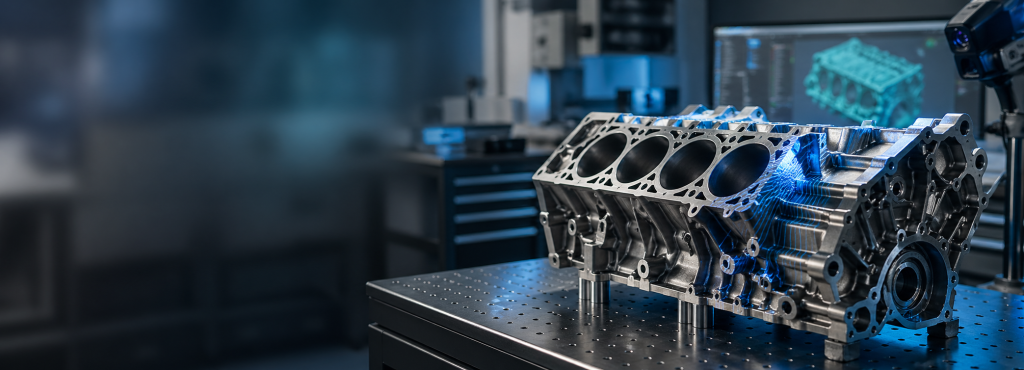
Modern casting technology gives engineers more design freedom than ever before. With 3D-printed sand molds and cores, complex internal passages, organic geometries, and rapid design iterations are possible without the tooling constraints associated with traditional pattern-making.
But greater freedom does not eliminate engineering tradeoffs. In many cases, it makes thoughtful decision-making even more important.
Successful casting projects are rarely attributed to a single breakthrough. More often, they result from a series of design choices that balance performance requirements, manufacturability, quality, and cost.
Designing with the End Goal in Mind
Every casting begins with a purpose. Material selection, operating environment, load requirements, machining needs, and performance expectations all influence how a part should be designed.
The flexibility of additive mold production allows engineers to pursue geometries that may have been difficult or impractical in the past. However, factors such as wall transitions, section thicknesses, internal features, and machining requirements still affect how metal fills, solidifies, and ultimately performs.
Rather than asking whether a design can be cast, the more valuable question is often whether it can be cast efficiently, consistently, and economically.
Engineering Collaboration Early in the Process
At Kimura Foundry America, engineers lead the quoting and development process from the beginning. This early involvement allows manufacturability, solidification behavior, and machining considerations to be reviewed while adjustments remain fast and cost-effective.
Because KFA and VIP Tooling work closely together, casting and machining considerations can be evaluated in tandem rather than sequentially. This integrated approach helps identify opportunities to improve manufacturability while reducing downstream revisions and unexpected costs.
Using Tech to Validate Decisions
Modern engineering tools provide valuable insight long before production begins.
Using MAGMA simulation software, KFA engineers evaluate filling and solidification behavior, optimize feeder design, and identify potential concerns before molds are printed. These simulations help reduce uncertainty and support better decision-making throughout development.
Validation continues after production through in-house testing and inspection capabilities, including CT scanning and other non-destructive evaluation methods. Comparing simulation results with actual casting performance allows engineers to continuously refine processes and improve outcomes.
Looking Ahead
As manufacturing technologies improve and evolve, engineers have more opportunities than ever to optimize designs for both performance and production.
The most successful projects are typically those where manufacturability is considered alongside performance at the start. When engineering, simulation, validation, casting, and machining work together early in the process, teams gain the ability to make better decisions, reduce risk, and achieve more predictable results.
Ultimately, better castings are not simply the result of better technology; they are the result of thoughtful engineering decisions made at the right time.