

In product development, speed is always a priority. Shorter timelines and earlier validation are now standard expectations. But in casting, moving faster can introduce risk—rushed decisions, late-stage changes, and costly rework.
The real challenge isn’t simply accelerating timelines. It’s moving faster with confidence.
At Kimura Foundry America, we’ve found that meaningful gains in speed don’t come from pushing production harder. They come from removing friction early in the process—at the stages where design intent is clarified, manufacturability is evaluated, and quality is validated well before a casting is poured.
Where speed is really gained
Many delays in casting projects originate long before production begins. Unclear design assumptions, late manufacturability discussions, and slow validation cycles can quietly add weeks to a schedule. By the time these issues surface, flexibility is limited and changes become expensive.
That’s why, at KFA, engineers lead the quoting and development process from the start. Early engineering involvement allows solidification behavior, casting feasibility, and downstream machining considerations to be addressed when adjustments are fastest and most cost-effective. With foundry and machining teams working in parallel rather than in sequence, projects move forward with greater clarity and fewer handoffs.
Turning innovation into practical acceleration
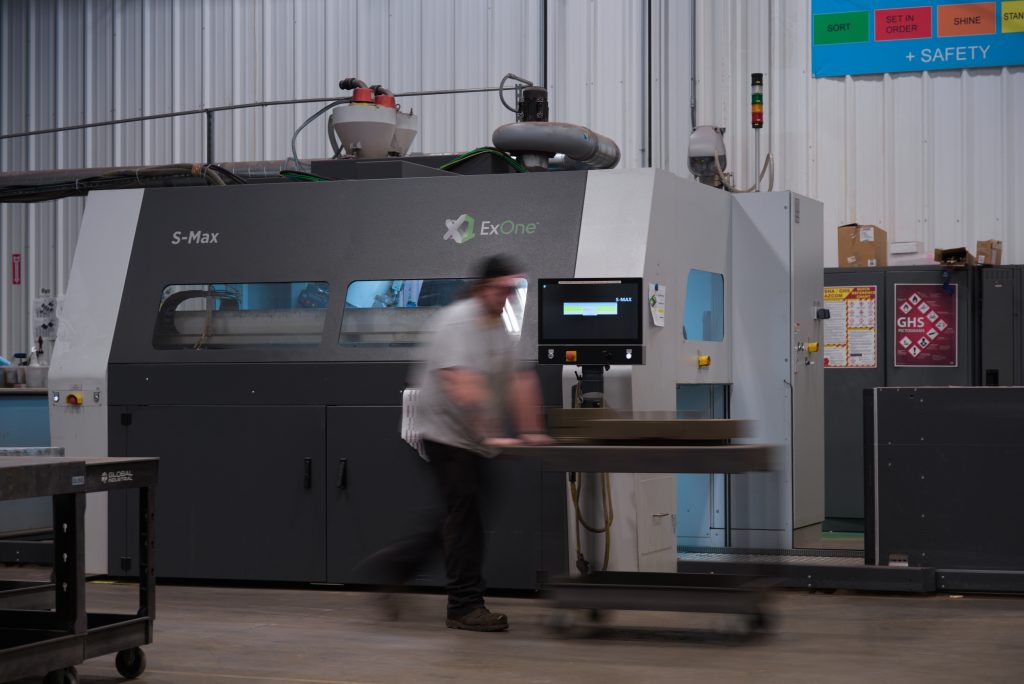
KFA’s casting process removes a major source of delay altogether. Using proprietary processes developed over decades, we produce castings directly from 3D-printed sand molds and cores, eliminating the need for traditional patterns or tooling. This allows teams to move from CAD to cast part without waiting for tooling to be designed, built, or modified—keeping early development agile and responsive.
Equally important is what happens before a mold is printed. Through solidification analysis, our engineers evaluate how a part will fill and solidify, identify potential failures, and optimize feeder and gating design to account for these early in the process. This simulation-driven approach reduces uncertainty, improves yield, and minimizes the need for trial-and-error iterations later.
Validation that keeps projects moving
Fast iteration only works when validation keeps pace. KFA’s in-house lab supports a wide range of mechanical and non-destructive testing, including tensile, metallography, ultrasonic, and CT inspection. Internal CT scanning enables precise evaluation of internal soundness without sectioning parts, providing rapid feedback while reducing material waste.
This closed-loop process allows engineering teams to compare simulation results with real-world outcomes, refine designs quickly, and validate assumptions without slowing development.
Looking ahead
As timelines continue to compress across industries, sustainable speed will come from better early-stage processes, not last-minute acceleration. When collaboration, simulation, and validation happen upfront, teams gain confidence sooner—and projects move forward with fewer unknowns.
For Kimura Foundry America, innovation isn’t about chasing new technology for its own sake. It’s about building workflows that help engineers and manufacturers move from concept to validated part with clarity, predictability, and confidence.